The short answer
Is the Karnak sound and light show worth it?
A direct answer on an evening of light and narration at Karnak, sold with private transfers and a guide: what the booking page promises, what 77 reviews suggest, and who should choose a daytime visit instead.
Pick your Karnak evening ↗Quick answer
For most first-time visitors to Luxor, yes, as a second Karnak visit rather than your only one. The booking page describes light and narration inside Karnak Temple after dark, with a private air-conditioned car, a guide, entry fees and bottled water included, and the 77 reviews that exist average 4.1. Pass on it if you want to read reliefs up close, are short on evenings, or want a rating above 4.5, and check the language of your night before paying.
The evening at a glance
| Karnak sound and light show, private tour | |
|---|---|
| Format | Light and narration in Karnak Temple at night, sold as a private tour |
| Length | About two hours, door to door |
| Included | Private air-conditioned car to and from your Luxor accommodation, entry fees, a guide, bottled water |
| Guide languages | Arabic, English, Spanish, Russian and German |
| Not included | Tips and meals |
| Cancellation | No charge until a day before the start, on a GetYourGuide booking |
| Setting | Karnak, part of the UNESCO-listed ancient city of Thebes |
| Check first | The show language and date on your booking calendar |
| Rating | Rated 4.1 by 77 reviewers |
Our verdict on the night show
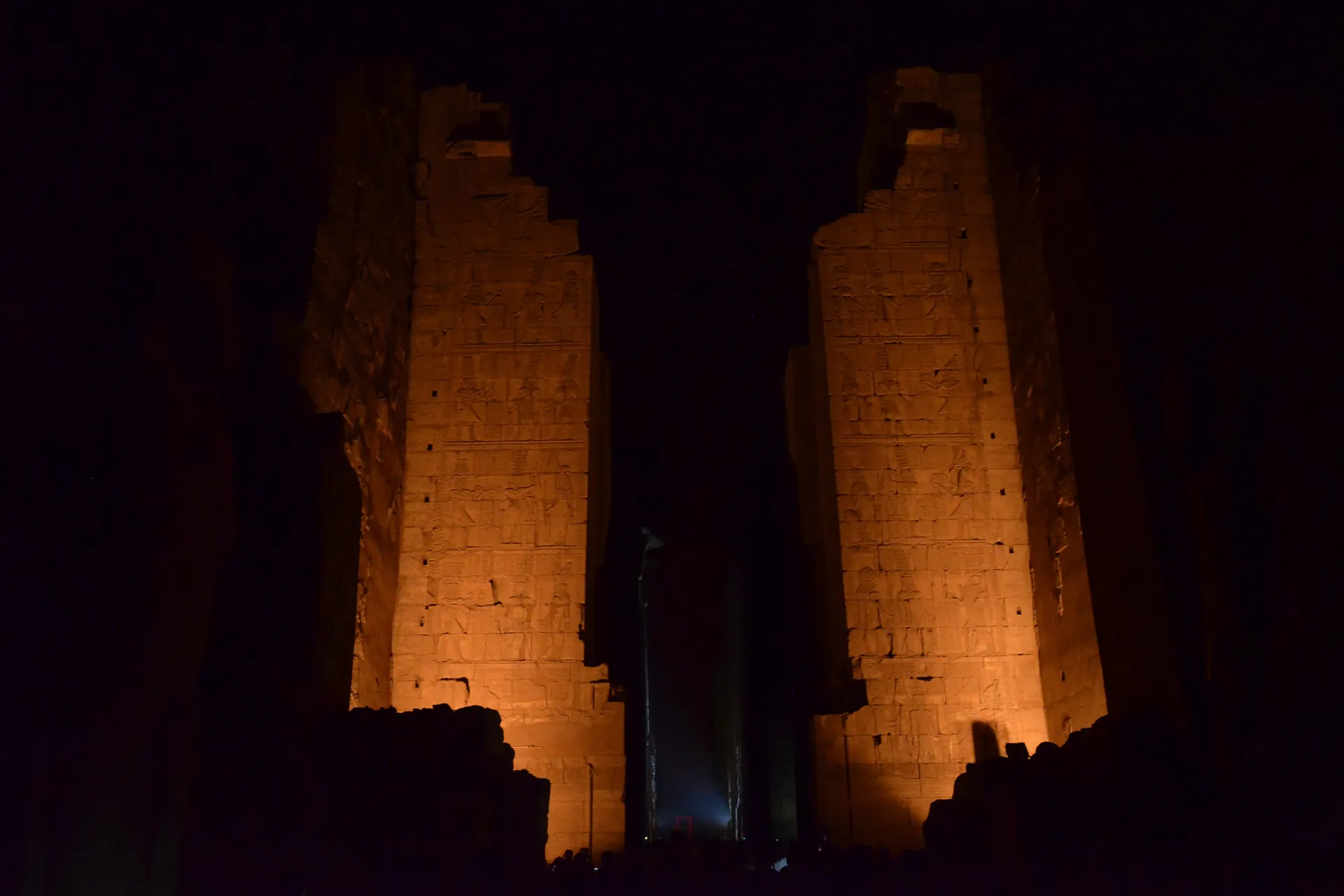
How far it repays an evening turns on what you want from Karnak. If you picture the temple's enormous columns and gateways rising out of the dark, lit in warm colour while a voice tells you who built them and why, this is that evening. The listing sets it out plainly: light and narration in Karnak Temple after dark, as a private tour with a car, a guide and entry covered. If you picture a slow wander with time to read the carved walls, a daytime visit does that job better, and an evening show will not replace it. Most travellers who ask the question are choosing between those two pictures, and the plain answer is that they are different products. The night show is theatre built on a monument; the day visit is the monument itself.
What the listing commits to
The listing is specific about the practical side. It is sold by a Luxor operator as a private tour, so the party is your own rather than a coach of strangers. A private air-conditioned car collects you from your Luxor accommodation and returns you afterwards. Entry fees are covered, a guide accompanies you in Arabic, English, Spanish, Russian or German, and bottled water is provided. Tips and meals are not included, so budget for both. The whole outing is described as about two hours, and a booking made through GetYourGuide can be cancelled at no cost until a day before the start. What the page does not give is a running order, a route through the temple or a start time you can plan a dinner around, so this guide invents none of them. Your booking calendar and confirmation carry the date, the language and the hour.
What the 4.1 rating can and cannot settle
A 4.1 is a decent score, though it sits below the daytime Luxor tours that gather thousands of ratings and score 4.6 or more. Two things explain part of the gap. The sample is small, 77 ratings, so a few let-down nights pull the score down harder than on a listing with thousands of reviews. And a night show is judged against expectations in a way a temple visit is not: people who hoped for a close look at the carvings, or for a cinema-style spectacle, can feel short-changed by a quiet, atmospheric evening. Take it to mean most people left happy and a minority did not, then use the rest of this page to decide which group you would fall into. The author has not attended the show, so none of this is first-hand.
What a sound and light show is, and what it is not
The format has a known pedigree. Wikipedia describes a son et lumiere as a nighttime show, usually at a historic site, in which lighting is projected onto a building or ruin and synchronised with narration and music to dramatise the place's history, and it credits the concept to Paul Robert-Houdin at the Chateau de Chambord in 1952. Nothing in that definition promises actors, close-up detail or a seat; the visitor mostly stands or walks and looks. At Karnak the setting does much of the work, because the stone is vast and the night hides the surroundings. Photographs on Wikimedia Commons from sound and light evenings show the great columns lit in amber against black, and a gateway glowing orange. That is the effect to expect, an atmosphere more than a lesson. If you want the lesson, the carvings are far easier to read in daylight.
Why Karnak is a good place for this kind of evening
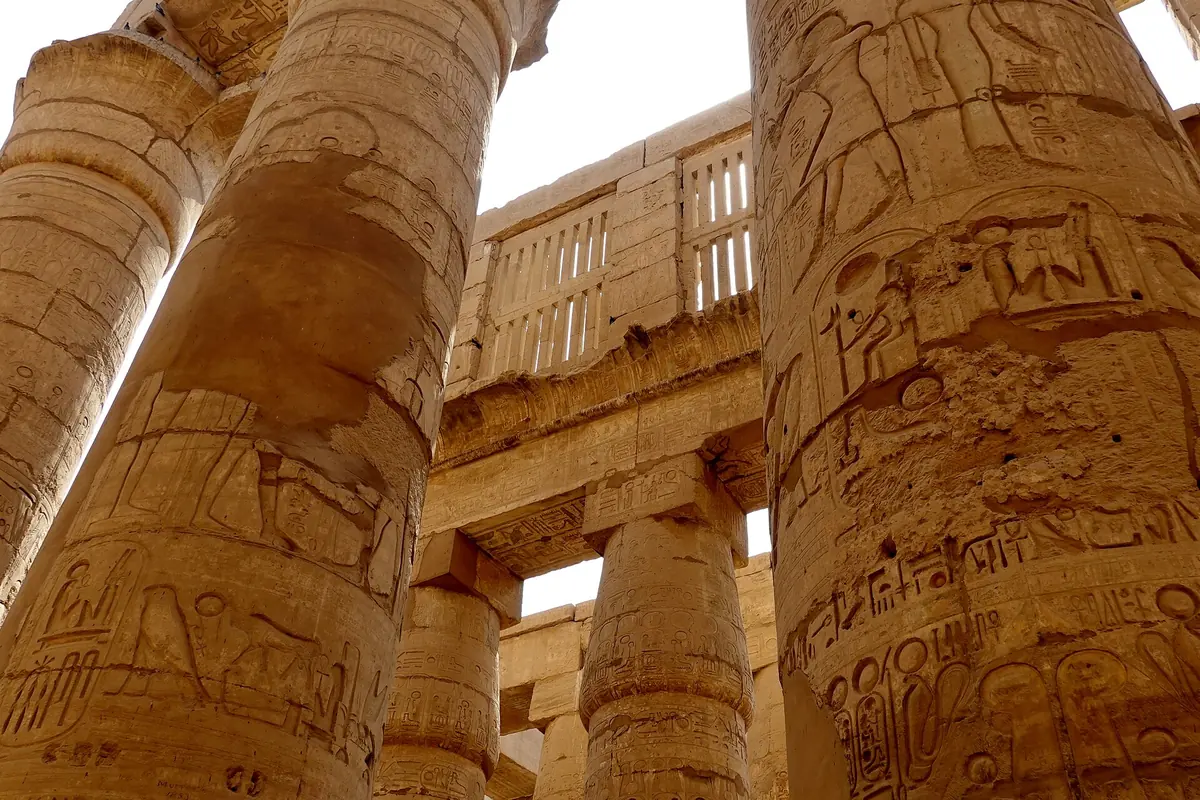
The scale is the argument. Wikipedia's article on the complex says building began under Senusret I, who reigned 1971 to 1926 BCE, and continued into the Ptolemaic period, which began in 305 BCE, with roughly thirty pharaohs adding to it. Few single features are unique, it notes; the size and number of them are what set Karnak apart. The Great Hypostyle Hall alone covers 5,000 square metres and held 134 columns in 16 rows, built mainly under Seti I and Ramesses II in the 19th Dynasty, around 1290 to 1224 BCE, which is well over 3,000 years ago. Lit from below at night, columns that size read as architecture and as stage set at the same time. A place with that much accumulated history gives a narrator plenty to say, and it gives a lighting designer a great deal to work with.
Who should book it, and who should not
Book it if this is your first visit to Luxor and you have an evening free, if you want your transport sorted so that you are not negotiating a taxi in the dark, if you travel as a couple or family and prefer a private party, or if you have already seen Karnak by day and want a second, different impression. Think twice if you are reading this on your only free day in Luxor, because the daytime temple will teach you more, if you are travelling with a toddler who will not manage a late outing, or if you dislike standing and walking on uneven stone at night. Think twice too if your language is not among the guide languages and you rely on narration in your own. And if a 4.1 on a small sample troubles you more than the rest of the facts, take the daytime tours covered in the comparison guide on this site.
How the private format changes the evening
Most night shows at heritage sites are group events, with a crowd gathered at fixed seats or a fixed route. This listing is different in structure, because it is sold as a private tour: your party, your car and your guide. The practical gains are real. Nobody waits for latecomers, the driver knows the way in the dark, and the guide can answer questions in your own language if it is one of the five listed. The trade-off is that you do not choose what the show does, since the light and narration follow the temple's programme. A private format also suits mixed groups, such as grandparents with teenagers, who want to move at different speeds. If you would rather share a vehicle with strangers to save money, this is not that product, and the daytime shared tours in the comparison guide are the alternative.
How it fits around the rest of Luxor
Luxor rewards a sensible order. The west bank, with the Valley of the Kings and Hatshepsut's temple, can fill a day on its own, and the east bank temples can fill another. An evening at Karnak therefore slots in after a west-bank day or a rest day, with dinner afterwards. Wikipedia's article on Thebes explains the logic of the two banks: the living city and its great temples to the east, the necropolis to the west. If you build your days on that division, the evening show becomes the east-bank finale of a trip that has already covered the west. If you arrive late in the day and leave early the next, the evening may be your only look at Karnak, in which case be realistic about how much detail you will take in.
What to settle before you pay
Three small decisions decide whether the evening goes well. First, the language: the show runs in set languages at set hours, so open the booking calendar, pick the date and confirm that your language is the one running that night before you commit. Second, the order of your days: if you plan a daytime Karnak visit as well, do that first, so that the night version feels like a second look rather than a first introduction. Third, the extras: tips and meals are not included, so decide in advance whether to eat before or after, and carry some small cash for the driver and guide if you intend to tip. Dress for cool desert air after sunset in the cooler months and for sandals on uneven ground in all of them.
Frequently asked questions
How do past guests rate it?
Seventy-seven reviews give it 4.1 on average, a fair mark on a small sample for an atmospheric evening rather than a guided study visit.
Is this a private tour?
Yes, the booking page sells it as a private tour with a private air-conditioned car, a guide, entry fees and bottled water.
Are tips and meals included?
No. The page lists tips and meals as not included, so plan to pay for both yourself.
Can I cancel?
You may cancel at no cost until 24 hours ahead when the booking was made on GetYourGuide; your confirmation gives the exact cut-off.
Sources
- GetYourGuide page for the Karnak sound and light show, read on 18 November 2026
- Karnak: the precinct of Amun-Re, its builders, dates and the Great Hypostyle Hall
- Great Hypostyle Hall: 134 columns, Seti I, Ramesses II and the 1899 collapse
- Son et lumiere: how a sound and light show is built
- Thebes, Egypt: the east-bank temples, the west-bank necropolis and the 1979 listing
- Amun: the hidden god of Thebes