The temple
The precinct of Amun-Re: two thousand years of building
What Karnak is, who added what, and why the temple you see after dark is a layered record of roughly thirty pharaohs rather than a single design.
Pick your Karnak evening ↗Quick answer
Karnak is a vast complex of temples, pylons and chapels near Luxor, begun under Senusret I in the Middle Kingdom and added to until the Ptolemaic period. Most of what survives is from the New Kingdom. The part visitors see is the precinct of Amun-Re, chief god of the Theban triad, and it grew by accretion: each king built, rebuilt or inscribed over the work of earlier ones.
Karnak's growth, from the sources
| Phase | What was added |
|---|---|
| Middle Kingdom | First building under Senusret I, reigned 1971 to 1926 BCE |
| 18th Dynasty | Thutmose I's enclosure wall between the Fourth and Fifth Pylons, the earliest part still standing in place |
| Hatshepsut | Twin obelisks at the entrance; one still stands, the other lies broken |
| 19th Dynasty | The Great Hypostyle Hall, mainly under Seti I and Ramesses II |
| 30th Dynasty | The First Pylon and the great enclosure walls, under Nectanebo I |
| Late antiquity | Temples abandoned; Christian churches founded among the ruins |
| Modern times | Listed with the rest of Thebes by UNESCO in 1979 |
A place with a name that means something
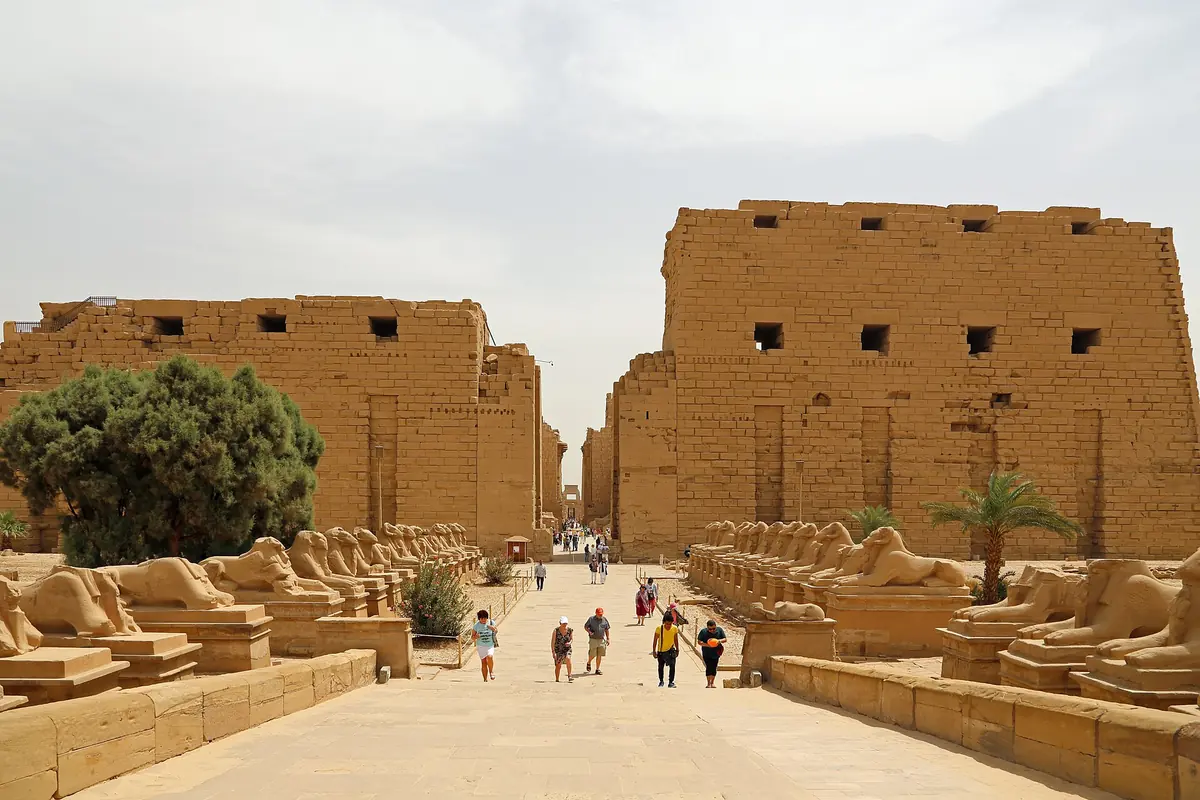
Wikipedia records that the ancient name was Ipet-isut, usually translated as the most select of places, and that the modern name Karnak comes from the nearby village of El-Karnak, which the article glosses as fortified village. The complex lies near Luxor, the modern city on the site of ancient Thebes. It was the main place of worship for the Theban triad, headed by Amun, whose name means hidden. Wikipedia's page on Thebes calls it still the second-largest religious building ever built. The point to hold onto is that Karnak is a precinct, a walled zone of many buildings, and that the term often means only the Precinct of Amun-Re, since that is the part most visitors enter.
How it grew
The article stresses the time dimension: the key difference between Karnak and most Egyptian temples is the length of time over which it was built and used. Construction began under Senusret I in the Middle Kingdom and continued into the Ptolemaic period, and approximately thirty pharaohs contributed. Major work happened in the 18th Dynasty, when Thebes was the capital of unified Egypt, and almost every king of that dynasty added something. That layering is why the plan looks unplanned: a processional axis runs through a series of pylons, with courts, halls, shrines and chapels clustered around it, some preserved, some dismantled and reused.
Obelisks and their stories
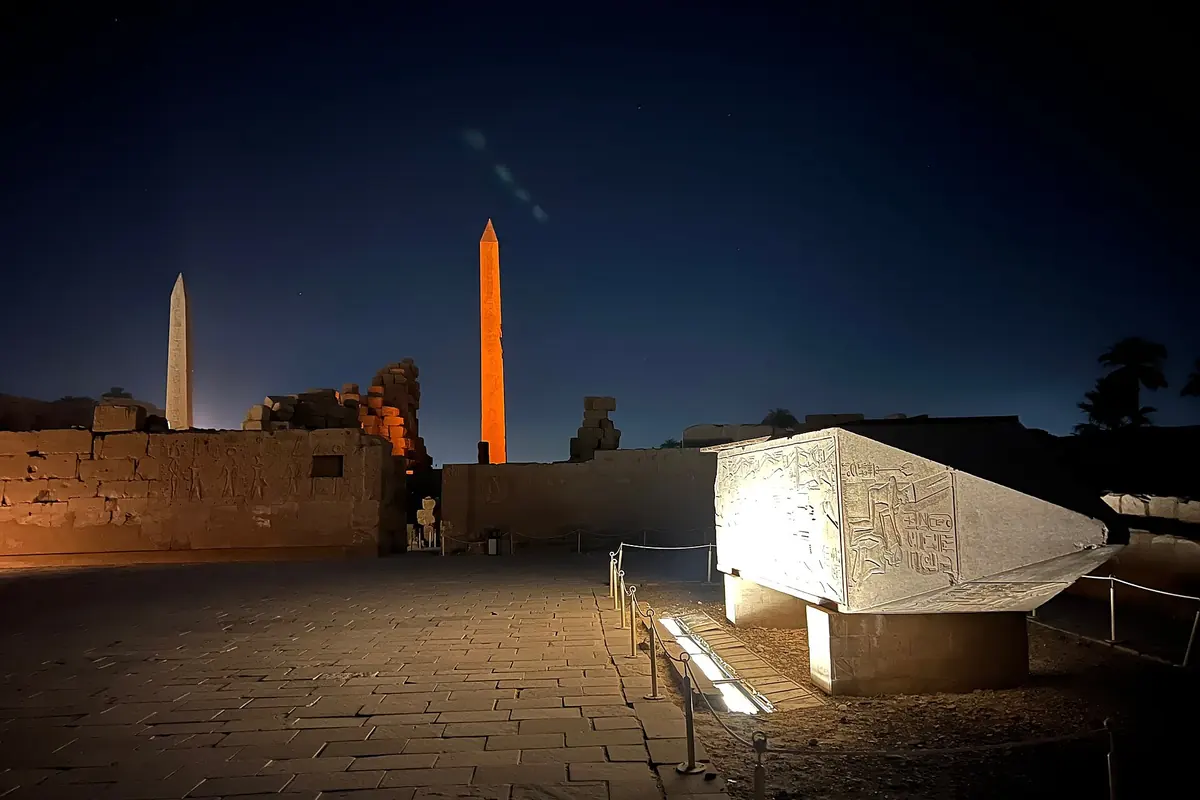
Hatshepsut had twin obelisks raised at the temple entrance, then the tallest in the world. Wikipedia says one still stands, as the second-tallest ancient obelisk on Earth, while the other has toppled and broken. She later ordered two more to mark her sixteenth year as pharaoh; one broke during construction and a replacement was made, and the broken one still lies in its quarry at Aswan as the unfinished obelisk, evidence of how such monuments were cut. Another obelisk at the precinct is given as 29 metres high and 328 tons. In the evening the standing obelisk is a fine target for lighting, narrow and tall against a dark sky.
Later kings, later faiths
The 19th Dynasty added the Great Hypostyle Hall, and Merneptah recorded victories over the Sea Peoples on the walls of the Cachette Court, where the processional route to Luxor Temple begins. The last major change to the layout was the First Pylon and the massive enclosure walls, built by Nectanebo I of the 30th Dynasty. After Roman rule and the end of the old religion, Karnak was largely abandoned, and Christian churches were founded among the ruins; the central hall of the Festival Hall of Thutmose III still shows painted saints and Coptic inscriptions. Even Akhenaten left a mark: his temple east of the main complex was dismantled after his death, so thoroughly that its layout is unknown.
Why this matters on the evening
A night show cannot cover all of this. It can show you a few of the biggest pieces and give you enough names to hang the rest on. Knowing the layers in advance lets you ask better questions of a guide and notice that the columns, the gateways and the obelisks belong to different centuries. If you have the time, read this page the day before, and look at the First Pylon photograph for the sense of the original entrance. Then, when the lights come up on the columns, you will know that you are looking at the work of a single reign inside a precinct that took nearly two thousand years to finish.
Frequently asked questions
What does Ipet-isut mean?
Wikipedia translates the ancient name as the most select of places.
How long was Karnak built?
From the Middle Kingdom, under Senusret I, into the Ptolemaic period, with about thirty pharaohs contributing.
Which part do visitors see?
Mostly the Precinct of Amun-Re, the largest of the complex's parts.
Is it a World Heritage Site?
Yes, it was added in 1979 together with the rest of ancient Thebes.
Sources
- Karnak: the precinct of Amun-Re, its builders, dates and the Great Hypostyle Hall
- Thebes, Egypt: the east-bank temples, the west-bank necropolis and the 1979 listing
- Great Hypostyle Hall: 134 columns, Seti I, Ramesses II and the 1899 collapse
- Hatshepsut: the obelisks at Karnak and the Deir el-Bahari temple
- Amun: the hidden god of Thebes
- GetYourGuide page for the Karnak sound and light show, read on 18 November 2026