The road
The avenue of sphinxes: from Karnak to Luxor Temple
The ceremonial road that once linked two great temples, how it was uncovered, and why Luxor's lit avenue makes a good companion to a night at Karnak.
Pick your Karnak evening ↗Quick answer
The avenue of sphinxes, also called the Rams Road, is a processional road of about 2.7 kilometres that connects Karnak Temple with Luxor Temple, lined with sphinx and ram-headed statues. It was uncovered in stages and reopened to the public on 25 November 2021 after more than seven decades of restoration work.
The avenue at a glance
| Avenue of sphinxes, Luxor | |
|---|---|
| Connects | Karnak Temple and Luxor Temple |
| Length | About 2.7 kilometres, according to Wikipedia |
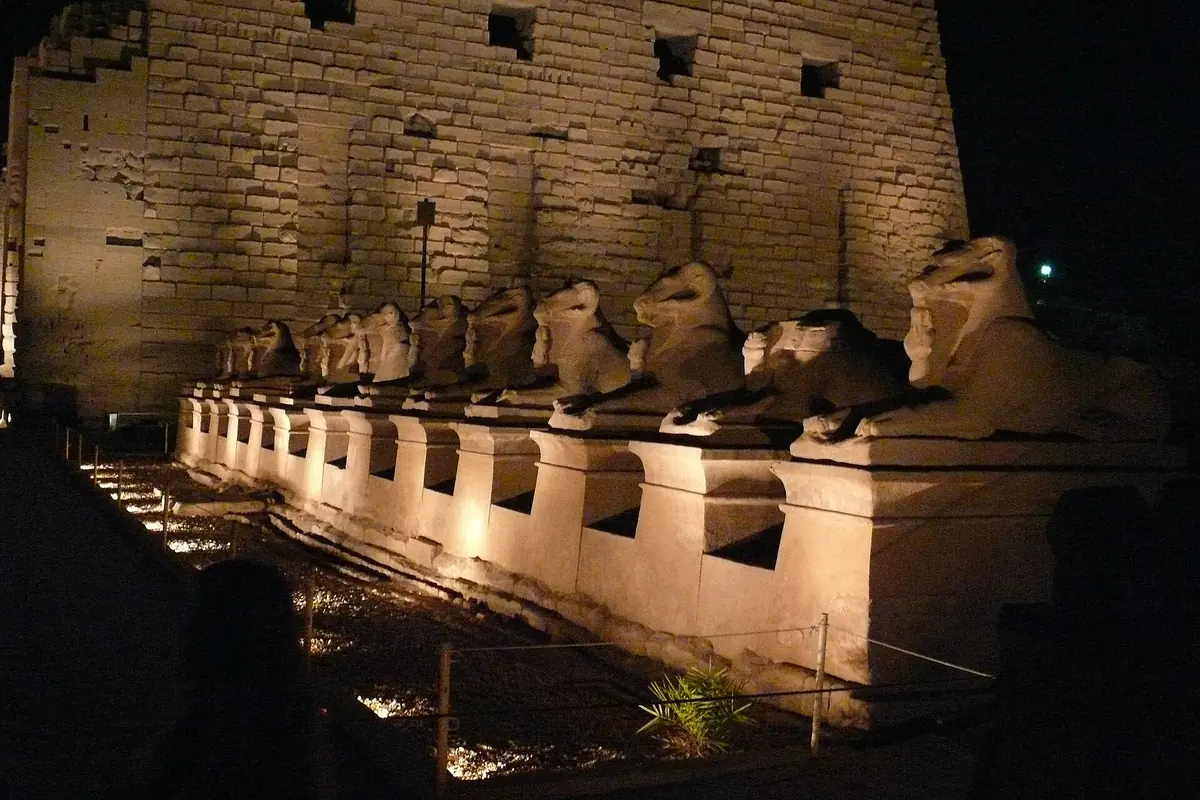
| Lined with | Sphinxes with human heads and ram-headed statues |
| Begun | In the New Kingdom |
| Completed | In the Late period, under Nectanebo I of the 30th Dynasty |
| Statues | 1,057 in total at the 2021 reopening: 807 sphinxes and 250 ram-headed |
| First traces found | 1949, near Luxor Temple |
| Reopened | 25 November 2021 after restoration |
A road for gods and kings
Wikipedia describes the avenue as a dromos, a ceremonial road, about 2.7 kilometres long, uncovered in the ancient city of Thebes and linking Karnak with Luxor Temple, with sphinxes and ram-headed statues along both flanks. Its purpose was religious: it carried the festival processions that moved between the two temples. Luxor Temple, Wikipedia says, was dedicated to the rejuvenation of kingship and may have been where many pharaohs were crowned, in fact or in idea. A road joining the god's great house at Karnak to the place where kingship was renewed ties the two halves of the east bank into one sacred landscape.
How it was built and lost
Construction began in the New Kingdom and was completed in the Late period, under Nectanebo I, who reigned 380 to 362 BCE. Over the centuries the road was buried under sand and later buildings. Wikipedia notes that the Description de l'Egypte of 1809 described it as 2,000 metres long and lined with over 600 sphinxes, and that at Luxor the road lay below the groundwater level, which made excavation hard. The first trace at Luxor came in 1949, when the Egyptian archaeologist Mohammed Zakaria Ghoneim found eight statues near the temple, and further finds followed through the 1950s and 1960s. From 1984 to 2000 the full route was established.
Sphinxes and rams
The article sorts the original 1,057 statues into three types: a lion's body with a ram's head, a full ram statue, and the sphinx with a lion's body and a human head, which makes up the largest group and lines the road toward Luxor Temple. Ram-headed figures are tied to Amun, whose animal was the ram, which is why they are found along the approach to his precinct. The human-headed ones carry royal features. Together they turn a road into a processional gallery, a long line of watchers between the two great temples of the east bank.
The 2021 reopening
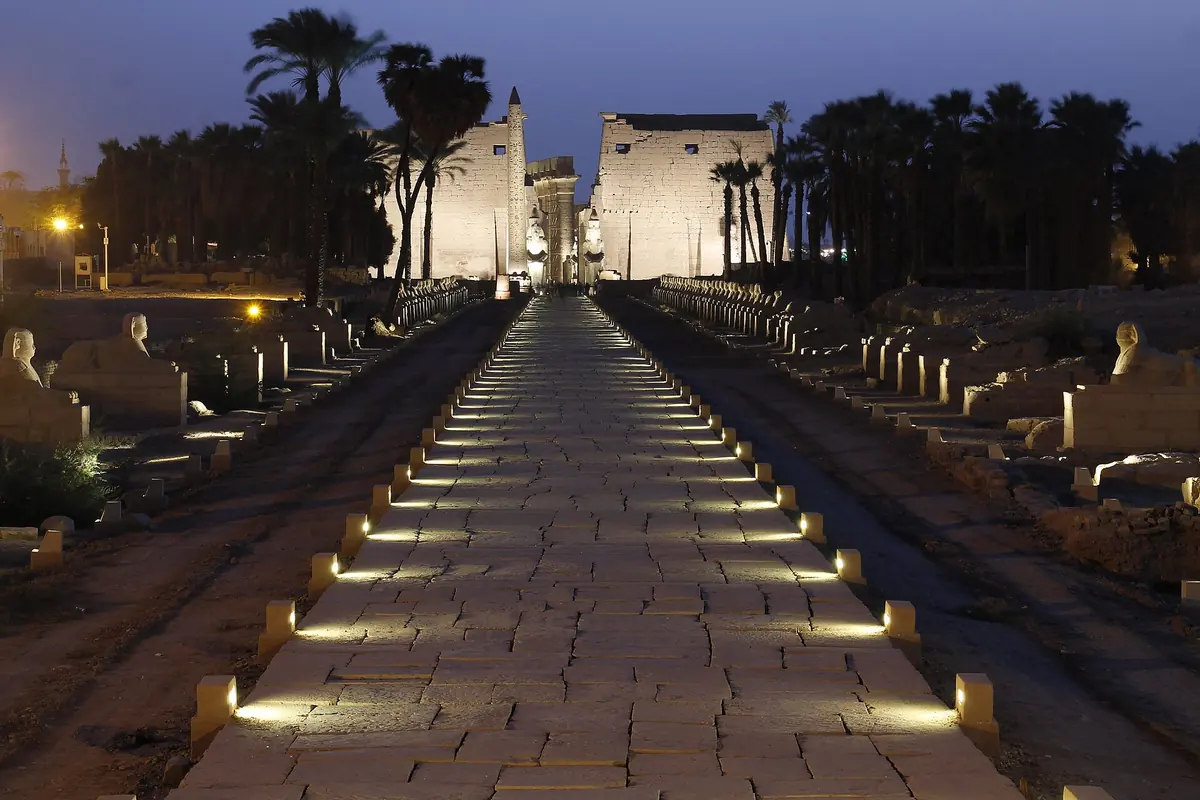
On 25 November 2021, the avenue opened to the public after restoration works that took more than seven decades. Wikipedia records a ceremony with participants in pharaonic dress, a symphony orchestra, lighting effects, dancers, boats on the Nile and horse-drawn carriages, and notes that the avenue was then lined with 1,057 statues, 807 of them sphinx-shaped and 250 ram-headed. Zahi Hawass called Luxor the largest open-air museum, a description the article quotes. For a visitor it means a long, level approach between rows of stone animals, particularly effective when lit.
Where this fits in a Karnak evening
The booking page for the Karnak evening describes light and narration inside Karnak Temple, with a private car, so the avenue is not part of that listing. It is, however, a natural companion on another evening, since the road is lit and runs from Karnak to Luxor Temple. Treat it as an optional extra: ask your guide or your accommodation whether a walk along it suits your dates, and confirm opening arrangements locally, since access can change. If you plan a short stay, the temple evening and one daytime visit are the priority, and the avenue is a bonus rather than a requirement.
Frequently asked questions
How long is the avenue?
Wikipedia gives about 2.7 kilometres between Karnak Temple and Luxor Temple.
When did it reopen?
On 25 November 2021, after restoration that took more than seven decades.
Why rams?
The ram was a sacred animal of Amun, the chief god of Karnak.
Is the avenue part of the Karnak evening ticket?
The booking page describes the show inside Karnak Temple and does not list the avenue, so treat it as a separate visit.
Sources
- Avenue of Sphinxes: the processional road between Karnak and Luxor Temple
- Luxor Temple: the rejuvenation of kingship and its 1979 listing
- Karnak: the precinct of Amun-Re, its builders, dates and the Great Hypostyle Hall
- Thebes, Egypt: the east-bank temples, the west-bank necropolis and the 1979 listing
- Amun: the hidden god of Thebes
- GetYourGuide page for the Karnak sound and light show, read on 18 November 2026